

Welcome to LORE, a weeklyish (emphasis on the ish) dispatch on how to build a reputation. If you aren’t already subscribed, you can do so here:
On Saturday, I joined the rest of Brooklyn’s female population and a few intrepid boyfriends at a showing of The Devil Wears Prada 2. It was good, as magazine writer Emily Gould attested, and my not-so-hot take is that if you liked the first one, you should probably see it.


But today I want to discuss not the film itself but the franchise’s legacy —specifically, how one Ms. Anna Wintour has, at long last, decided to embrace her alter ego, Miranda Priestly.
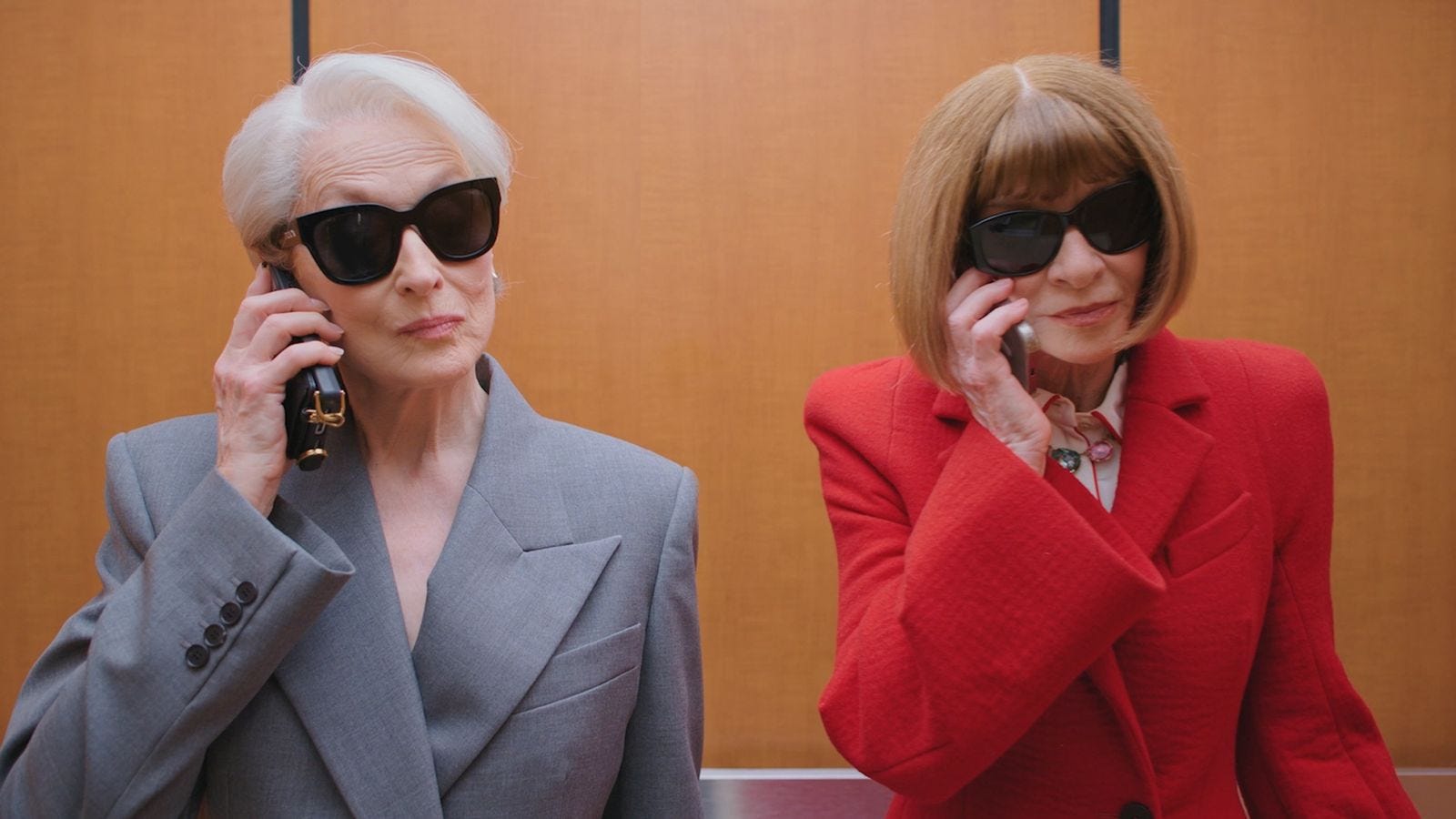
To understand why this matters, let’s first transport back nearly a quarter-century to 2002, when Women’s Wear Daily announced that a roman à clef written by former Vogue assistant Lauren Weisberger had sold to publisher Doubleday for a reported $250,000. (The movie followed in 2006.) When Anna learned about the book, she reportedly said, “I cannot remember who that girl is.” A year later, in advance of the book’s release, she quipped to a New York Times reporter, “I always enjoy a great piece of fiction.”
The great irony is that these reactions were incandescently Miranda. Thus the line was forever blurred between Anna and the character she allegedly inspired — to everyone, that is, except Anna Wintour and Vogue. For the next 20 years, Anna continued to stay mum on the topic. There was Anna, and there was Miranda. Condé Nast’s communications strategy could be summarized as: ne’er the twain shall meet.
But in those intervening two decades, several things happened. A generation of Millennial girlie pops grew up dreaming of magazine jobs that no longer existed. (I know because I was one of them; we all wound up working in tech comms instead.) The horrors of The Devil Wears Prada — the fur coats flung with abandon, the blatant body shaming, the $8 Jarlsberg grilled cheeses — started to seem almost quaint in comparison to the rolling horrors of techlash, #MeToo, COVID layoffs, remote work, return to office, and AI layoffs.
And as we all weathered this novel iteration of the workforce, one so different from the fluffy, bright-pink one we’d imagined in the early aughts, The Devil Wears Prada became comfort food. Its many quotable moments became memorialized as memes (and management, as I plan to write more about soon, is memeing). I mean, has any movie spawned quite as many quotable phrases?
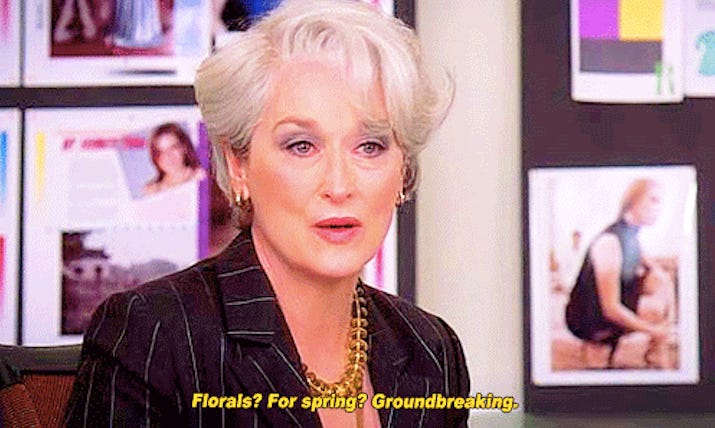
“Florals? For spring? Groundbreaking.”
“That’s all.”
“By all means, move at a glacial pace. You know how that thrills me.”
“Gird your loins!”
“Details of your incompetence do not interest me.”
And, of course, every line of the perfect cerulean sweater speech
Indeed, when I secured an early copy of a scathing book about a client during my days at a comms agency, I called it my Devil Wears Prada moment, harkening to the moment in the movie when our protagonist Andy secures copies of the unpublished Harry Potter manuscripts for Miranda’s twins.
The sum total of these memeable moments was a kind of softening. If the original message of the movie was a cautionary tale of a horrendous work environment, an ode to being true to yourself, over time the movie instead became encased in a haze of nostalgia, softened by age and the erosion of the industry it satirized. We started to love Miranda. The Dragon Lady became symbolic of a dreamworld, a once-was, a could’ve-had. And in that shift, Anna saw an opening.
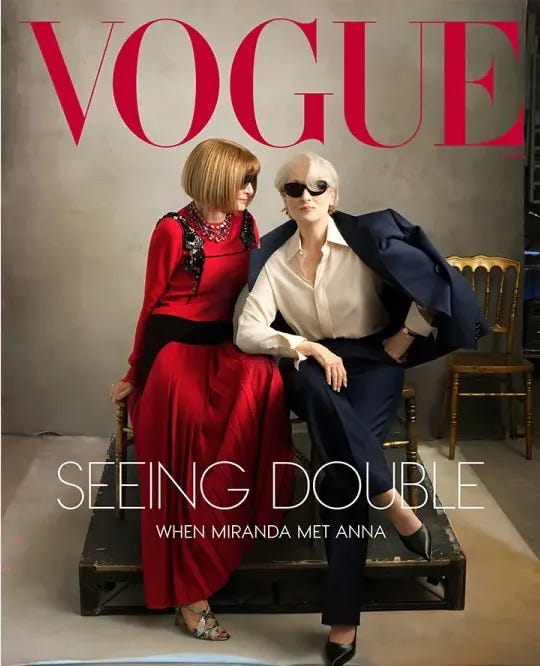
She and Meryl — who deserves her flowers for playing the ice queen Miranda with such pathos one can’t help but love her, or at least respect her in a “Yass, Queen!” kind of way — posed together on the cover of Vogue. The title was Seeing Double.
Meanwhile, Vogue’s new Head of Editorial Content Chloe Malle — for it was decided the glossy would retire the Editor-in-Chief title with Anna, another canny-if-Machiavellian legacy-preserving move — interviewed some of the magazine’s former interns in advance of the movie’s release. (Not to be outdone, Amy Odell, the Robert Caro of the #girlboss, kicked off a series featuring much more harrowing intern stories on her excellent publication Back Row.)
This is all to say: Anna and Vogue are leaning in this time around. They know the public sees Anna and Miranda as one, and they’ve realized Miranda is ultimately lovable, or at least memorable — and as magazines continue to wither, memorability is essential to creating an enduring legacy.
We might summarize the larger lore lesson here as thus: If you can’t beat ‘em, join ‘em. By the time you’re a meme, you’ve been flattened and oversimplified — but you’ve also become a kind of cultural shorthand. You can’t escape your own meme-ification, but you can harness it. I suspect this was really hard when the first book and movie came out; Anna probably thought, “This isn’t fair! This is so one-sided.” Yes. And. It became a cultural moment, or what the brilliant Lulu Cheng Meservey calls a cultural erogenous zone. And at the heart of culture is love, or something like it.
There’s a lot of power in that, if you can get past the unfairness of having nuance and complexity reduced. And over time, if the public loves you, they just might let some nuance and complexity creep back in, codifying your lore with something like respect.