

Welcome to LORE, a weeklyish newsletter and podcast about how to turn narrative capital into capital capital. If you haven’t already subscribed, you can do so here:
Recently most of our work at 1st Principles has centered on narrative strategy. This means we’re helping companies articulate what they do and why it matters — what we, perhaps unsurprisingly, call lore.
As an output of this exercise, people often expect a mission and vision. These statements are regularly included in brand exercises, so anyone who’s been in the game a while has been trained to expect these components. Typically a mission is what the company is working on currently, what you do for whom right now, and a vision is the big-picture goal, the way the world might change if everything goes right.
The problem is these two concepts quickly get conflated. For instance, Google’s mission is “to organize the world’s information and make it universally accessible and useful.” Is that a mission or a vision? In my view, it’s somewhere in between, a blurry version of both — something that sorta-kinda explains what the company does today while being vague enough to cover most of what they might do in the future.
This is why most company missions and visions suck. They’re either so narrow they inspire no one, or they sound like pageant queens advocating for world peace, a dream big and vague enough to be completely useless. (Good company communications should repel as well as attract — if no one can disagree with you, no one can meaningfully agree with you either.)

So after doing some dozen or so of these exercises over the last year, I’ve come to believe visions are overrated. They require a level of certainty that almost no startup has in the early days. It’s like trying to plot a novel before you’ve even started brainstorming the characters.
In fact, I think writing a novel is an apt metaphor here. One of my favorite quotes about the process is from E.L. Doctorow: “Writing is like driving at night in the fog. You can only see as far as your headlights, but you can make the whole trip that way.”
In the earliest days, founders have to manage a lean set of resources, applying them keenly to the highest-impact problems. But early on, you don’t know yet what the highest-impact problems are, just as few novelists know what their book will be about before they force their way through a first draft. I started my own novel thinking it was a tale of second adolescence; in fact, upon revision, it’s turning out to be a story of money, security and the American Dream. Many companies pivot once they’re an entire act or two in, realizing the thing they’ve been building is actually better suited for some other purpose, is telling some other story.
“Writing is like driving at night in the fog. You can only see as far as your headlights, but you can make the whole trip that way.”
- E.L. Doctorow
Most startups would be better off, then, without these lofty vision statements — with just some headlights in the fog. Or to use another transit-focused metaphor, this one perhaps apocryphally attributed to Antoine de Saint Exupéry, “If you want to build a ship, don’t drum up the men to gather wood, divide the work and give orders. Instead, teach them to yearn for the vast and endless sea.”
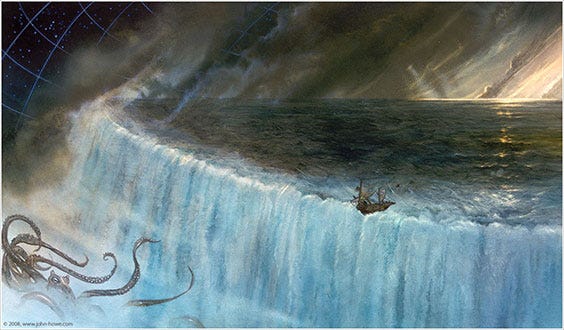
Ironically, I often see this quote employed by fellow tech operators to demonstrate the importance of having a company vision. The assumption is that a vision is what people yearn for. But in practice, a vision is more often the destination, the utopia assumed to be on the other side of the ocean. Except we rarely know what’s on the other side of that oceanic expanse. It may be the Indies; it may be the Americas; it may be the end of the world. If you put too much stock in any particular vision, you create mercenaries, people on the journey for the end destination, people almost certain to jump ship (ha ha) as soon as things get hard.
“If you want to build a ship, don’t drum up the men to gather wood, divide the work and give orders. Instead, teach them to yearn for the vast and endless sea.”
- Antoine de Saint Exupéry (except probably not)
Most companies do not need an end goal. They need to have headlights, a short-term goal carrying them forward, like winning a customer contract or creating a robot that can fold laundry. And they need to have an appetite for the vast and endless sea, a love of sailing, of building, of driving in the fog, of chaos and camaraderie. If you must call either of these things vision, fine. But the reality is most company visions come later, after the spin of gaining traction, after a few pivots.
This is why I like to think of lore as an emergent property — not something external to a company, but something earned through the accumulation of decisions over time. Usually these decisions are made under genuine uncertainty, the things a company did when the map ran out, when they got to the edge of the known universe and kept sailing.
major +1. saw this sentiment echoed in Andy Jassy's latest shareholder letter where he discusses at length how company trajectories are rarely straight lines (they're "squiggly lines") and the need to pursue multiple paths until it's clear what will drive desired results