


Welcome to LORE, the best newsletter on communications and company culture. This is hitting your inbox a little later than usual today because I am but human and screwed up the schedule send. If you haven’t already subscribed, you can do so here:
It’s never been a better time to be a communicator in tech. With “storytelling” in high demand, salaries are soaring into the high six figures, and communicators increasingly report directly to CEOs rather than being seen as a purely marketing function. Yet despite (or perhaps because of) comms’s rising star, it’s also never been harder to find great communications talent. In the last month alone, I’ve spoken with multiple growth-stage founders and VCs struggling to find the right match for their first comms, marketing, and content hires.
This difficulty is due in part to comms’s ever-expanding scope. Today, comms might handle a range of responsibilities including media relations (aka talking to journalists), social media, blog posts, web copy, creative and design, events, brand, content and editorial, physical media, audio and visual, narrative, public policy, and more.1 As comms becomes an ever-more splendored thing, there become infinitely more versions of “good” (and yet even more versions of “bad”), and selecting among them becomes increasingly difficult.
So, without further ado, here’s a guide to hiring great communications talent in today’s market.
Hiring Guide
1. Hire for core skills, not tactics.
Communicators need, first and foremost, to be able to hold business strategy. Comms is a business function whose whole job is to move the business forward — by, say, attracting the best technical talent, warding off regulators, or driving customer acquisition. I am being dramatic in my italicization because if you take nothing else from this guide, THIS is the point. The profile you’re looking for is that of a businessperson who happens to spike in comms.
There are a surprising number of excellent tacticians out there — people who can wheel ‘n’ deal with reporters or craft a viral tweet — who don’t understand the why behind their work. This is dangerous. It is, for example, how Cluely wound up attention-hacking their way a base of rabid fans (good comms)…who were totally different people than their actual users (bad business). Find someone who can hold the center.
This means you should be open to candidates without “traditional” comms experience. Traditional comms experience is just another way of saying “tactical expert.” But great business strategists come from lots of different backgrounds, and you can teach them the tactical parts (or better yet, they’ll pick it up themselves — tactics are changing faster than playbooks, anyway). The great Jon Wu, for instance, was an private equity investor and management consultant before he became a positioning expert. What would it look like to hire a former engineer to lead community strategy or a documentarian to craft your narrative?
2. Be really clear about what you’re looking for (and what you’re not).
As I said above, comms is a multi-headed hydra. No one is equally good at every part of it; the crisis communicator that can talk down a Times reporter is not the same person that will tweak your copy until it relentlessly converts is not the same person that will host your late-night tech talk show. (Real talk: I want to start this, so who wants to join our panel of comedic commentators?)
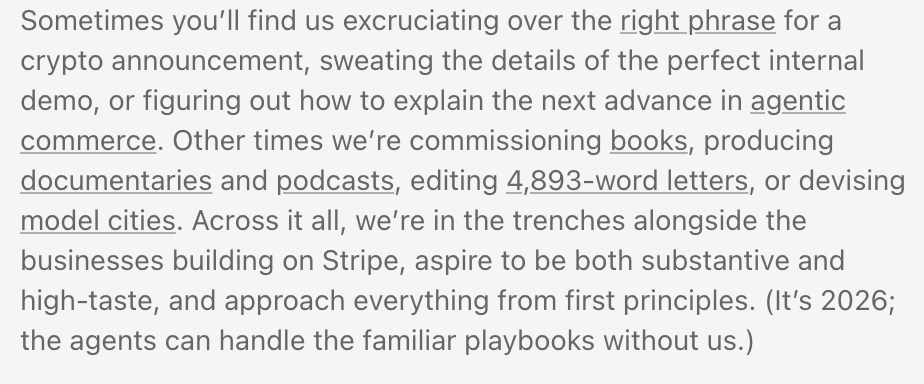
Your JD should reflect what you’re actually looking for. Stripe put out a killer example of this yesterday, launching a microsite for comms applicants. (The site was built on Lovable, the build-anything app, which had its own great comms week.) Here’s what the site does well that you can take into your own JDs:
Connect comms to the mission. This shows you understand how comms (say it with me kids) moves business goals. No one wants to be in a sideshow function.
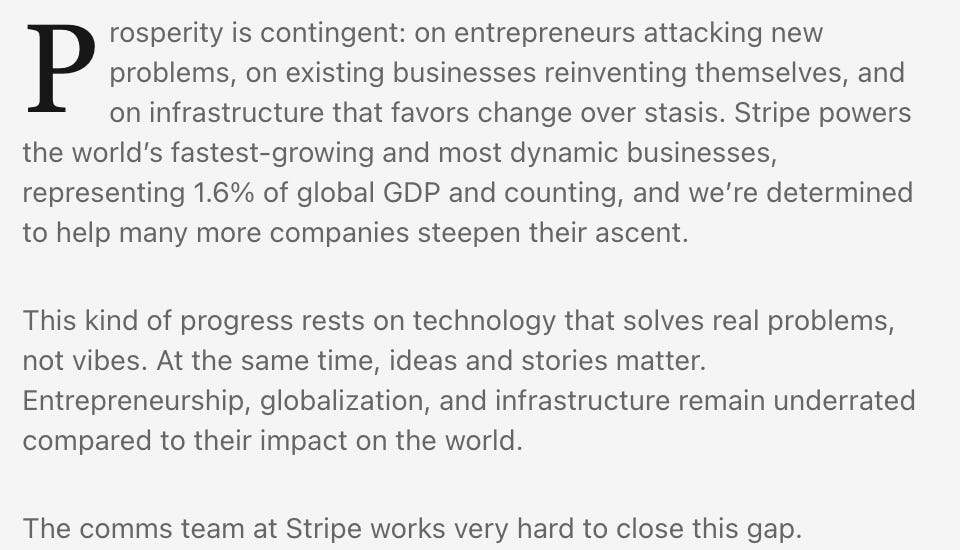
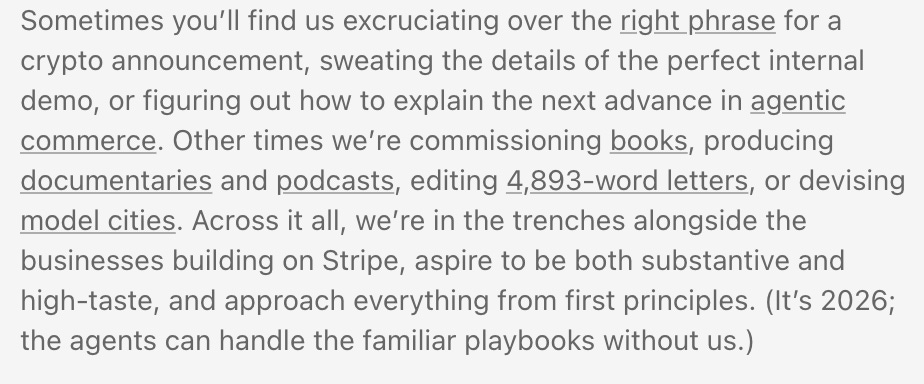
Explain what the role actually does. Again, comms means lots of things. You can lean into that multiplicity if your comms team does lots of things, as Stripe does. You can also, instead, indicate that you’re focusing on only a few things — for instance, an early-stage startup might say they’re looking for someone primarily to convert revenue, and that they’re intentionally deprioritizing broader narrative and brand work right now.
Assess taste and drive.
You don’t need someone who’s done this specific work before. You do need someone who’s relentlessly driven high-quality projects to the finish, over and over. To assess drive, I like this element of Stripe’s application.

My favorite interview question to assess taste is, “What do you think our company should be known for?” It allows you to quickly understand whether the candidate groks your current market position as well as where you ought to go.

3. Pay well.
The best communicators may be fielding lots of inbound offers, and many of them are weighing them against consulting opportunities that, in total, might bring in mid-six figures a year (or more). But surely that’s just the senior talent, right? You may ask. Nay! Great comms talent — even those with just a few years of experience, if any at all — are being hovered up by places like a16z and Notion. If you want someone who is truly a strategist — who is going to multiply the value of your business, not just write some blog posts while serving, fundamentally, as a cost center — you gotta pay up.
And good communicators are worth it, because their work pays for itself many times over. What is a single excellent engineering recruit worth to you (having a reputation as a cutting-edge company that’s a great place to work will help close them)? What’s it worth to close your next round closed in three weeks instead of three months? Hint: probably very high: Fundraising is, as Paul Graham notes, a massive energy suck.
Now Hiring
Besides Stripe, here are a few great startup comms roles open right now:
Ankar, Marketing and Comms Lead (London)
Who they are: Ankar is an AI-powered patent operating system founded by two ex-Palantirians. They just closed a $20M Series A led by Atomico with Index Ventures, on top of a seed round seven months prior. The product gives patent professionals tools as innovative as the ones they protect, turning the slow, fragmented patent lifecycle — idea capture, novelty search, drafting, prosecution — into a single AI workflow.
Why this role: Legal tech darlings Harvey and Legora are the hottest companies in vertical AI right now — but their products don’t touch patents. Join an early-stage company that already has the proof points of clients like L’Oreal and AmLaw100 firms, just as they start to expand massively.
Northwood Space, Head of Communications (LA, DC)
Who they are: Less than a year after a $30M Series A, Northwood just raised a $100M Series B and landed a $50M Space Force contract. The company builds ground infrastructure for satellite communications — aka the antennas that let Earth talk to space.
Why this role: You’d report directly to the founding team with a meaty mandate that spans media relations, product storytelling, and strategic announcements, just as the company is entering a serious scale phase.
Valon, Narrative and Brand Lead (NYC)
Who they are: Valon is building the AI-native operating system for regulated finance (think: mortgage servicing, but that’s just to start). They manage over $100B in loans across 500,000+ mortgages, just deepened a partnership with Rithm Capital to bring their platform (ValonOS) to Newrez’s 4 million homeowners, and have posted 400% year-over-year growth. Backed by a16z with $230M raised to date.
Why this role: Valon’s job listing is one of the clearest recruiting-focused comms briefs I’ve seen. They’re explicitly hiring someone to own their external narrative with a recruiting lens — crafting content that makes their mission legible to top-tier talent, partnering directly with recruiters to close candidate objections through storytelling, and building an employer brand engine from scratch.
Wait! You might cry. Isn’t some of this just marketing?! Yeah, maybe. Comms and marketing are a Venn diagram, and every company will draw their dividing line differently — though, FWIW, my thesis is that marketing is becoming more focused on revenue growth, while comms increasingly owns the overall story and narrative. This is why Chief Communications Officers increasingly report directly to the CEO, not the CMO, as Axios report (and also why CCOs are the next COOs, but I digress…).