

Welcome to LORE, a newsletter about how to turn narrative capital into capital capital. If you’re not yet subscribed — well, what are you waiting for?
Spend ten minutes among comms professionals and you’ll hear it on a loop: So how are we actually using AI to write? I keep getting slop.
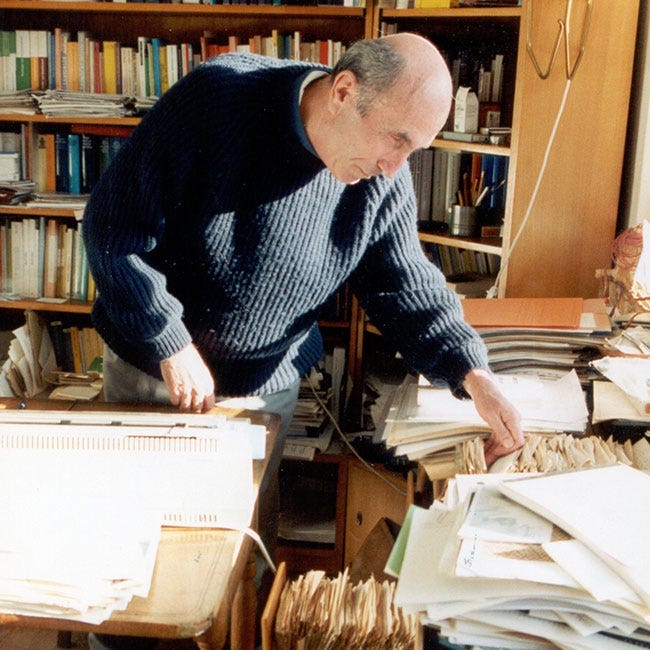
The answer starts with a 20th-century German sociologist by the name of Niklas Luhmann. Niklas was a prolific writer, long before AI made that a trivial feat, and attributed his output to a branching, non-linear notetaking approach called Zettelkasten, or the slip-box (basically, index cards).
I am not thinking about everything by myself; this predominantly happens in the slip-box.
- Niklas Luhmann
Though Luhmann died a quarter of a century before the launch of GPT-3.5, his approach provides the antidote to AI slop, because it understands what AI actually needs to do better in order to write well.
The Brand Book Is A Period Piece
Every brand already has a Brand Book.
Take it off the shelf of any comms shop from the last two decades and you’ll find the same physical artifact in marginal variations: the Messaging Guide, the Manifesto, the Key Message Memo, the Voice and Tone Guide. Its unceremonious life began in a conference room where six consultants ran through a SharePoint presentation while sitting squeezed together at the long end of the table, and then tens of pages were beautifully laid out by some long-suffering designer and signed off by twelve stakeholders.
Thanks were exchanged, and since, the file remains unopened in a “Brand” subfolder tucked away in another folder titled “Agency.”
The problem was mistaking this Brand Book for the ingredients of lore. That’s the equivalent of telling Claude that Frodo lives in the Shire and is off to save hobbitkind, and then asking it to write the rest of Lord of the Rings. You left out the Fellowship, Tolkien’s 15 constructed languages, Frodo’s transgression, and, you know, the entire quest. In other words: the lore.
This is The Brand Trap, and it’s the single most expensive mistake comms is currently making about AI.
Maybe you were told you could feed the model your two-hundred-page Brand Book or a zip folder of executive communications and it will “sound on brand.” What you got back from Claude was instead a series of generic descriptions: Authoritative but warm. Direct but never rude. Confident, with occasional vulnerability.
The reason you’re getting slop is you’re building the wrong object.
Tend the Loop
So, what’s the right object?
In Build Your Own Lore, I shared eight ingredients — e.g. a good quest, shared language, reliable guides — so you know what you should be working with. The object my friend David Johnson-Igra (who runs AI content marketing consultancy Scribes and was recently featured in Fortune) sold me on is a constantly improving system.
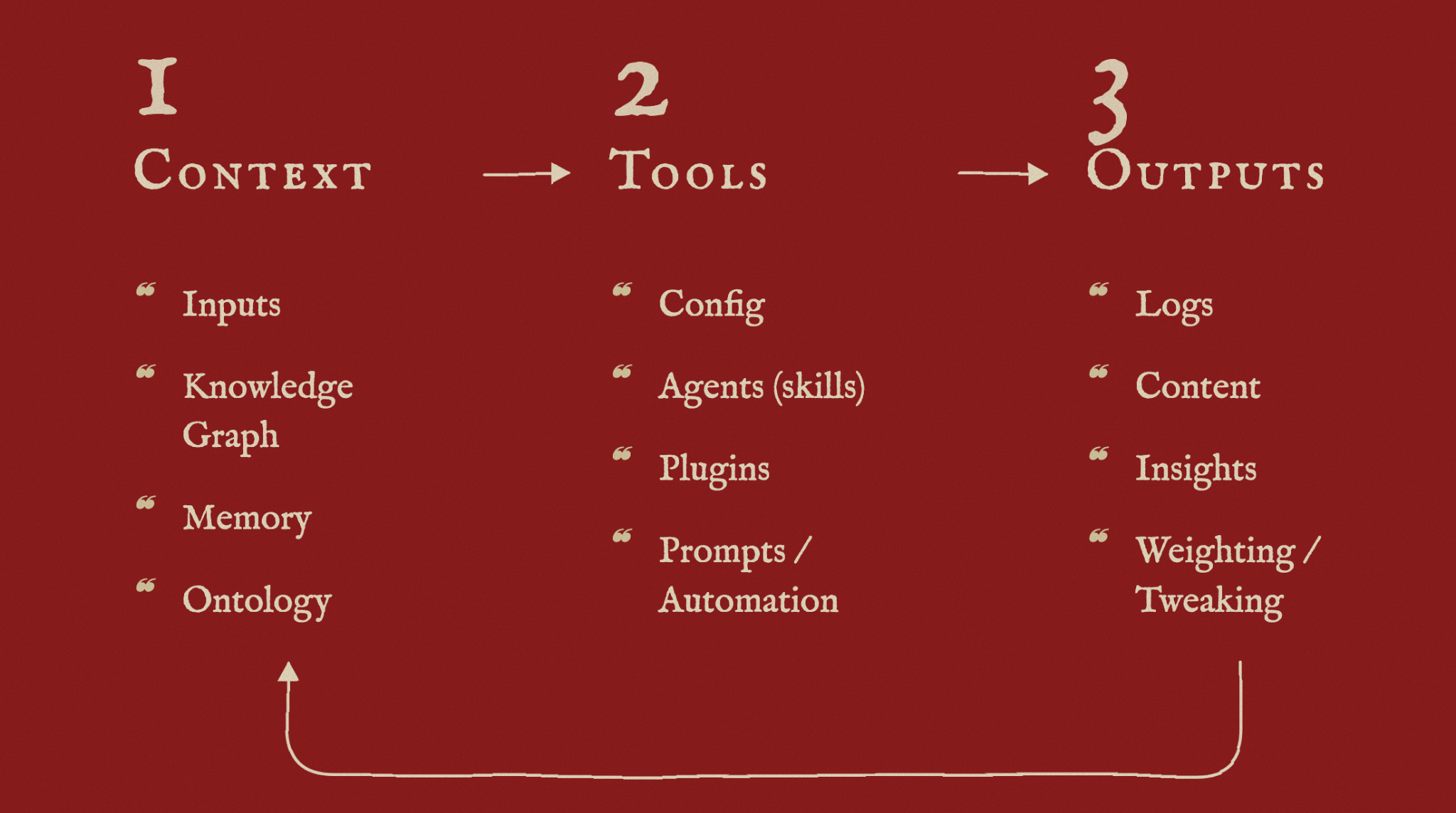
Context is where the ingredients live — ontology, memory, knowledge graph — in a shape a model can read, like a markdown file. Tools are the reliable guides, digitized: agents, plugins, prompts doing what your team used to do by instinct. Outputs are what come back as signals. They signal whether the system is capturing your bible, attracting the right people, repelling the wrong ones. (You want both. Especially the second.)
But the part that makes this a system and not just a slightly fancier Brand Book is the arrow taking your context, feeding into tools, then outputs, and back again. It’s evolving, just like your lore.
The Memetic Ontology
So what goes in as an input to create lore? Mostly memes. (Because management, ultimately, is memeing).
Not internet memes — the older sense, the Dawkins sense, the smallest replicable units of cultural transmission. The phrases your CEO reaches for when a specific kind of problem comes up, or the case study that the head of product can’t stop naming, or the internal joke that survived the fancy rebrand.
Let’s call this the Memetic Ontology. This is an extension of what I’ve previously called Shared Language. What I didn’t fully say at the time was that Shared Language is just the human-grade memetic ontology, the version that lives in employee onboarding decks and Slack rituals. A model-grade memetic ontology lives in a structured graph, tied to a system that the AI can learn from.
Importantly, you don’t write these memes. You observe them. They’re already in the executive’s last 18 months of writing, the all-hands transcripts, and the customer calls. The Memetic Ontology is mostly retroactive, and the job is excavation, not invention.
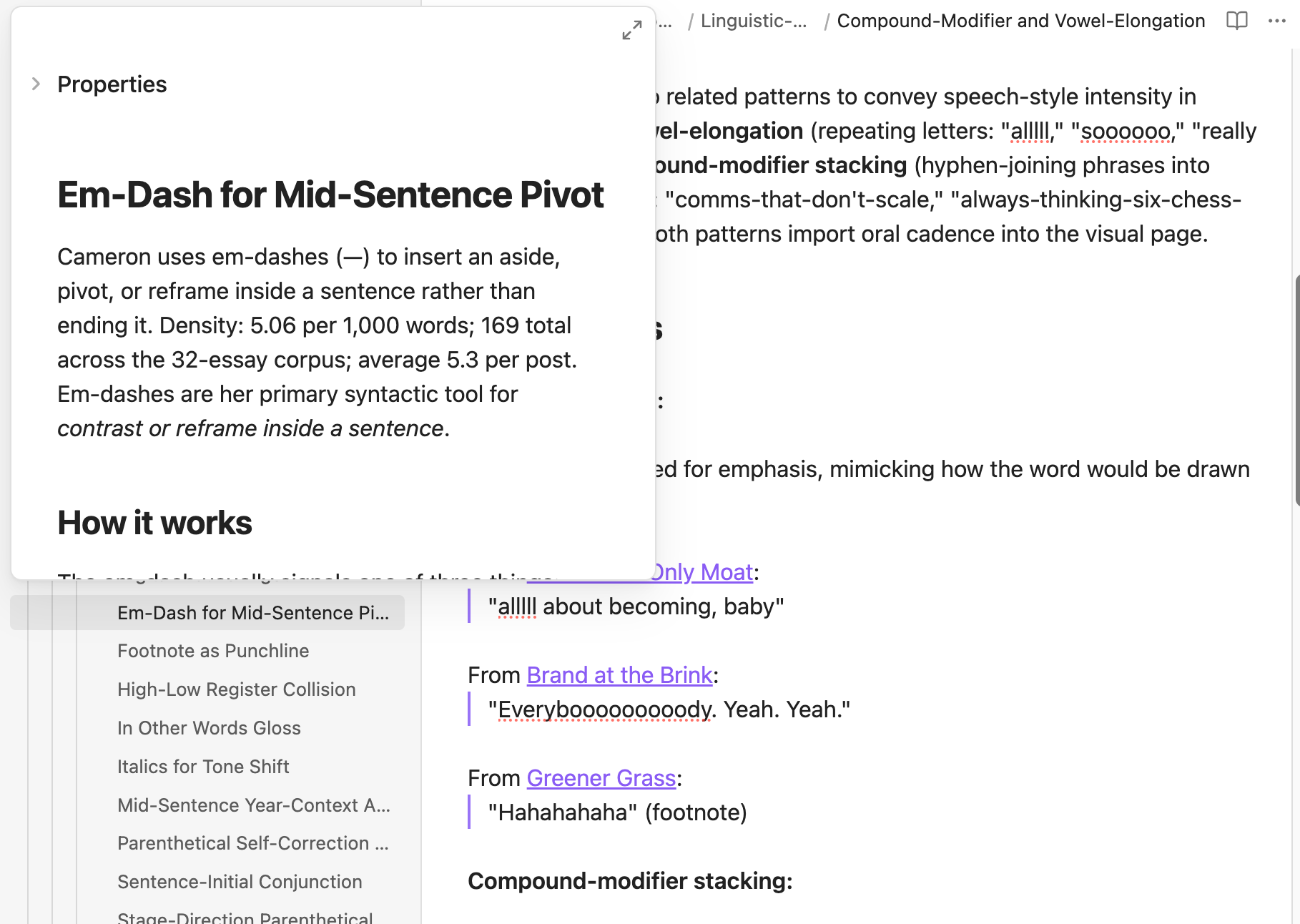
When David built mine, he had a model read every issue of LORE I’ve ever published. He directed the model to build a knowledge graph that digested key patterns: each Capitalized Concept I’d coined as an atomic note, each linguistic move I make over and over (italics-as-tone, em-dash-as-pivot, the way I always reach for Palantir as my go-to example) as its own tagged pattern, the binary differences between how I write a personal essay versus an argumentative one. None of that was invented. All of it was already there. The job was seeing it, and then deciding which pieces mattered and which were noise.
Which brings us back to the original question: How are we actually using AI to write?
Luhmann was prolific because his slip-box allowed ideas to connect in a way that linear notetaking did not. An old note would surface alongside a new one and reveal a relationship he hadn’t seen when he first wrote it down. The system did the synthesis; Luhmann did the judgment.
Done right, this is what a well-built LLM system can do for a company’s lore: metabolize what’s already true about you, surface connections across time, and keep improving as the story evolves. Brand governance stops being a document someone signs off on and starts being a loop you tend.
It’s also what David did for me — he created a LORE brand system and used it to draft this post. The first version felt like it was written by my fraternal twin, someone almost-but-not-quite me. The second and third versions felt much closer to how I think, not just how I write, because I was able to call out what felt wrong and feed that back into the model.
The Brand Book was always trying to approximate this. It just couldn’t evolve in real time, so it was always one step behind, reflecting what your brand used to be.
So this closing line, which I endorsed, was written by the system: The brand bible isn’t coming back, baby. Tend the lore loop.
The richness of this post... chef’s kiss. Bookmarked to come back to whenever I need a refresher.
Hail to the brand bible!