

Welcome to LORE, the best newsletter on communications and culture for growth-stage companies. If you haven’t subscribed yet, well, what are you waiting for?
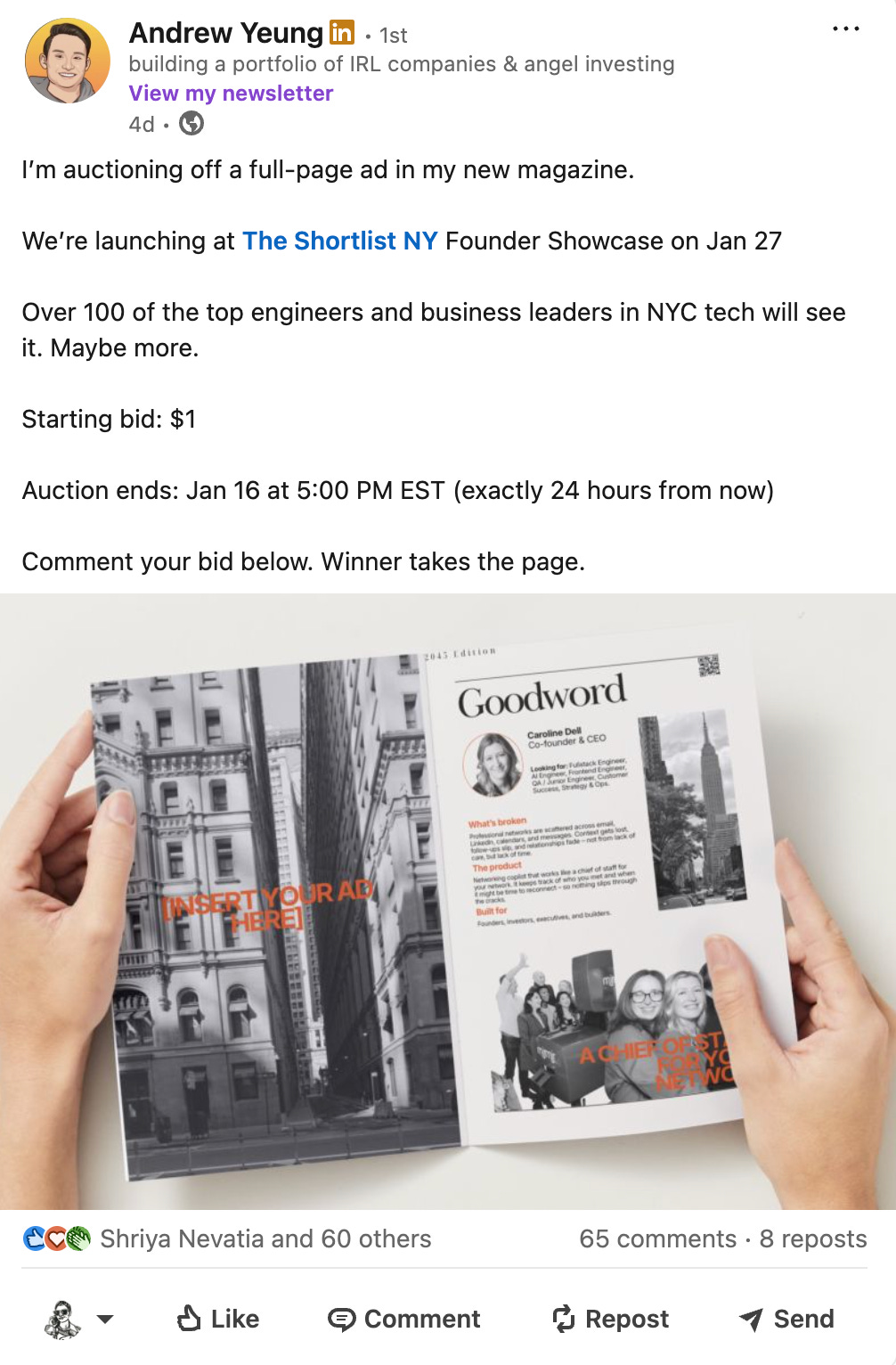
Recently I saw a LinkedIn post from Andrew Yeung. Once called the Gatsby of Silicon Valley, Andrew is something of a professional party-thrower, a bringer-together of tech folk. He’d put together a magazine for an upcoming IRL Founder Showcase and was auctioning off an ad.
The starting bid was one dollar. 24 hours later, in a two-minute break between calls, I sniped the winning spot at the actual, honest-to-God last minute for $1,650.
In case you’re even worse at math than I am, that’s 1650% markup.
I wanted to use the slot to advertise this here newsletter, LORE, which, by the way, is free. So why might I do something that, at first blush, looks so idiotic? Something my accountant might describe as “deranged” or “a complete misunderstanding of the function of a business expense”?
Let me explain, dear reader. For there’s a lesson in audience here.
The General Public Is Dead
Every company, politician, celebrity, piece of legislation, novelist, filmmaker, and theologian is speaking to someone. Probably several somebodies, but definitely not to everybody, and that is the point. These somebodies are what we might call audience.
There, I’ve shared it, the secret to communications: Know thy audience and speak to them; don’t worry about everyone else. Okay, now we can pack up this newsletter and shut it down. That’s all there is to know about comms.

Maybe there’s a little more nuance than that. But not much, tbqh. To explain, it’s helpful to bring in some historical context.
Once upon a time, in a faraway time known as the 1950s, “audience” was a relatively homogenized phenomenon, at least if you lived in the United States. Families huddled around Walter Cronkite at night; everyone read the front page of The New York Times over coffee before work. If you wanted to do something like sell people a dishwasher or announce a corporate merger, you knew where to find them: Why, they were huddling around Walter Cronkite at night and reading the front page of The New York Times before work!
There were only so many avenues to get your news into the world, is what I’m saying. Communications was a relatively blunt tool.
Now, in what one Twitter poster, in a post I can no longer find, called the Q2 of the 21st century, attention is fragmented across a thousand platforms and micro-conversations. People get their news from TikTok influencers and group chats, from Substack newsletters and Reddit threads. To reach any audience, let alone many, you have to deeply understand who they are and where they tune in amongst the byzantine maze of our modern information and entertainment ecosystem.
Which brings me back to that $1,650.
My bet is that Andrew and I have significantly overlapping audiences. He’s cultivated a fellowship of over 80,000 followers on LinkedIn and over 50,000 on Substack, but what matters aren’t the raw numbers. What matters is that he and I are speaking to the same people: startup founders obsessed with growth and building generational companies.
That’s why I’m making the bet that, even though the print edition of Andrew’s magazine will only reach a hundred or so founders, that small group will be zealously interested in what I’m doing here at LORE and subscribe. (Also, Andrew posted about my antics on LinkedIn, and that’s already driven over a 10% increase in subs.)
Meanwhile, if I’d published an ad in, say, Fly Fisherman’s Weekly, even if for some reason Fly Fisherman’s Weekly had ten zillion subscribers, I doubt LORE would see a single subscriber out of it. Fly fisherman are not my people (apologies to the fly fishing community), and any overlap between the fictional Fly Fisherman’s Weekly and LORE would be entirely coincidental, quite possibly compromised solely of my father.
There’s a lesson here for founders: Suss out where your audiences actually live and talk to them there. This sounds obvious, but in practice, our egos are bound up in all sorts of ideas that contradict this, like, Successful tech founders have to launch in TechCrunch or My emotionally distant grandfather will be so proud if I land the Bloomberg story. But often, if your goal is to drive revenue, you’re better off landing a trade story or niche podcast episode, or perhaps partnering with micro-influencers. If you want to reach talent, a Reddit AMA or an excellent YouTube video might go farther.
You can reach five million people and discover not one of them is your kinda people.
You’re better off going, as the good mermaid Ariel said, where the people — YOUR people — are.

The lesson? Don’t get seduced by big audience numbers. Your audience ≠ The General Public; The General Public is dead. Find your own people, then go to them where they already are.
Additional Reading
“Growth over going viral” from Link in Bio, featuring this great and relevant insight from BÉIS senior social media manager Paige Tapp:
[G]oing viral isn’t the most important thing on social media. Reaching the intended audience and connecting to them in a meaningful way is.

Join the Quest
As I’ve pontificated about before, building a generational company requires an eye for LORE. So if you’re new here—if you’re just joining our quest, quite possibly on the recommendation of new friend of the letter Andrew—here are a few of my favorite pieces to get you started:
Thanks for joining!
Love it
captivating writing
you make me reflect on a seemingly obvious subject matter in ways i never had