


Welcome to my new readers, and thanks for reading LORE, the best newsletter on how to to build a generational company via communications and culture. If you’re not already subscribed, you can do so here.
In today’s newsletter, we’re looking at what an idiosyncratic Air Force colonel can teach us about communications. The short version: You don’t need a strategy; you need to test, learn, and test again.
The Heretic
John Boyd had a habit of setting neckties on fire. This wasn’t metaphorical. Once, when an argument got heated (and Boyd’s arguments always got heated), the U.S. Air Force Colonel jabbed his lit cigar at his opponent until the ash burned through the fabric.
Except, it was also metaphorical. Boyd was constantly trying to prove that the Air Force was an old fuddy-duddy, a bow tie vying for futile relevance in a brave new world. Boyd wasn’t interested in tradition. He cared only about what actually worked — and he knew what worked, because he’d been an instructor at the Fighter Weapons School in Nevada in the 1950s, where, amid heat shimmer and Joshua trees, Boyd issued a standing challenge to any pilot brave enough to accept: Gun him down within 40 seconds from right on his tail.
He never lost. According to Ron Catton, one of the few pilots to graduate from the Weapons School with a perfect score, Boyd usually needed only twenty seconds but “liked a little insurance.” U.S. Naval Institute students came for him. Marine pilots came for him. Navy pilots. Pilots from a dozen allied nations. The closest anyone got was Marine aviator Hal Vincent, who fought “Forty Second Boyd” to a draw.

The secret was what Boyd called “flat-plating the bird,” turning the F-100 Super Sabre at ninety degrees, bleeding energy in a controlled way that seemed to violate physics.
But the deeper insight was conceptual: Victory wasn’t about raw speed or power. It was about agility. Whoever could change energy states faster — losing altitude to gain speed, trading speed for position — controlled the fight.
In other words, the pilots who won dogfights weren’t the ones with superior firepower. They were the ones who could think faster. Who could observe, orient, decide, and act before their opponent finished observing.
Boyd called this the OODA loop, and he spent the rest of his career getting into screaming matches with generals who wanted to plan their way to victory instead of OODA-ing.
Strategists had strategy. Boyd had something more dangerous: a theory of speed.
You Don’t Need A Communications Strategy
Here’s how that applies to comms: Your startup doesn’t need a Communications Strategy. At least not the way most people mean it. You do not need to lock yourself in a tower to pontificate about how to reach people. You need to see what sticks by executing quickly to get good feedback.
As communicator-turned-venture-capitalist Ashley Mayer, formerly of Box, Social Capital, and Glossier, puts it:
Tactics are more amenable to creativity and experimentation, don’t devour massive resources, and come with shorter and simpler feedback loops. With tactics, you can see what resonates and then build a strategy around what’s working.
This doesn’t mean there’s not a role for lowercase-s strategy. You should act with intention even when moving fast: After all, the OODA loop is 75% “figure out what to do” (the OOD of OODA loop) and only 25% “doing it” (the A). There are also moments, like big pivots, acquisitions, and other inflection points, where zooming out can be valuable. But you need to repeat the cycle recursively, over and over, with enough velocity to see different results and understand what actually happens when your plan makes contact with reality.
An OODA Loop for Comms
So what does an OODA loop for comms actually look like?
1. Observe
Listen. What’s the market saying? What’s resonating in your category? What are reporters writing about? What are candidates asking in interviews? What just happened that changes the landscape?
2. Orient
Interpret. Filter those signals through your company’s reality: positioning, strengths, gaps. This determines everything downstream. Get orientation wrong and speed kills you faster.
3. Decide
Commit (for now). Pick the message, the channel, the moment. What are we saying, to whom, and why now? Make the call.
4. Act
Ship it. Publish, pitch, post, brief. Put the narrative into the world. Every action generates new data, which feeds your next observation. The loop continues.
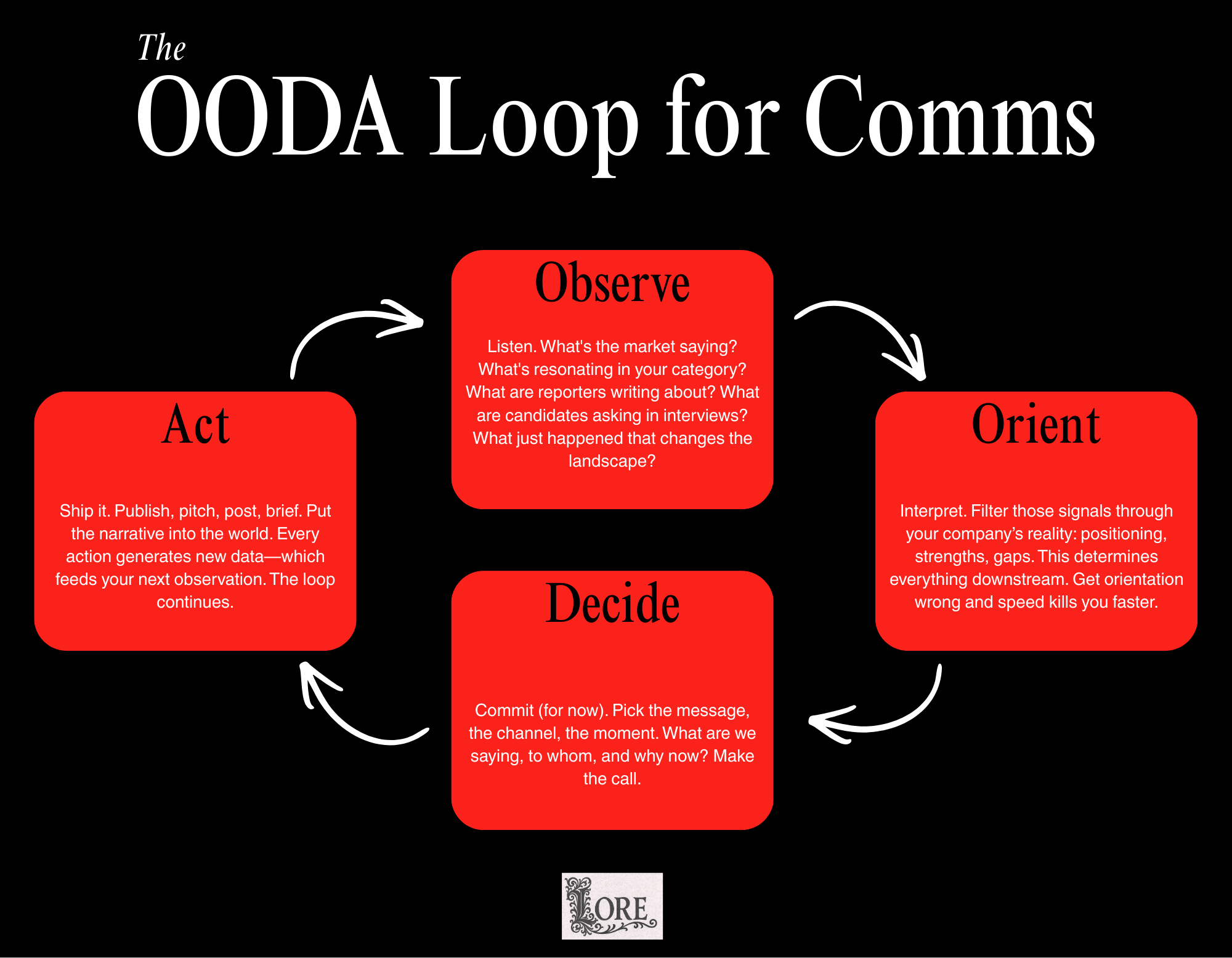
For startups, the OODA loop is a discipline of execution. When Salesforce launched, Marc Benioff watched what landed, adjusted, and did it again. The strategy was emergent rather than origin. The “No Software” logo and fake protests outside Siebel conferences allowed Benioff to iterate his way into a positioning as the insurgent, the inevitable replacement for legacy software. All those tactics accumulated into a strategy, and by the time competitors had a response, Benioff owned the category.

This is what I mean when I talk about lore. Companies with real narrative capital — the kind that converts into recruiting advantages, investor confidence, and customer loyalty — don’t build it through strategic planning in an ivory tower, divorced from ground reality. They build it through trial and error, through accumulation. Story after story, appearance after appearance, message tested and refined until it becomes part of how the market understands them.
Narrative capital snowballs. But only if you’re already in motion.
I live and breath the OODA.